Study facts at a glance
Participants: Ninety people enrolled; 15 withdrew before randomization, and 75 completed the three-treatment trial. Their actual ages ranged from 29 to 65. Source 1
Follow-up: Each treatment period lasted 22 weeks, making approximately 66 weeks across all three periods—not 22 weeks total. Source 1
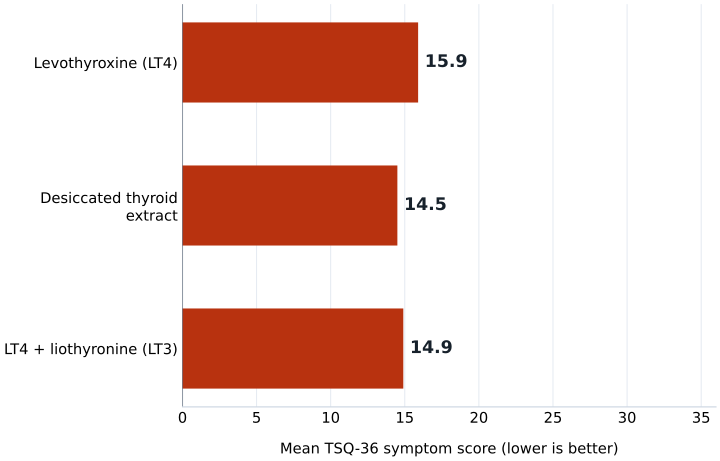
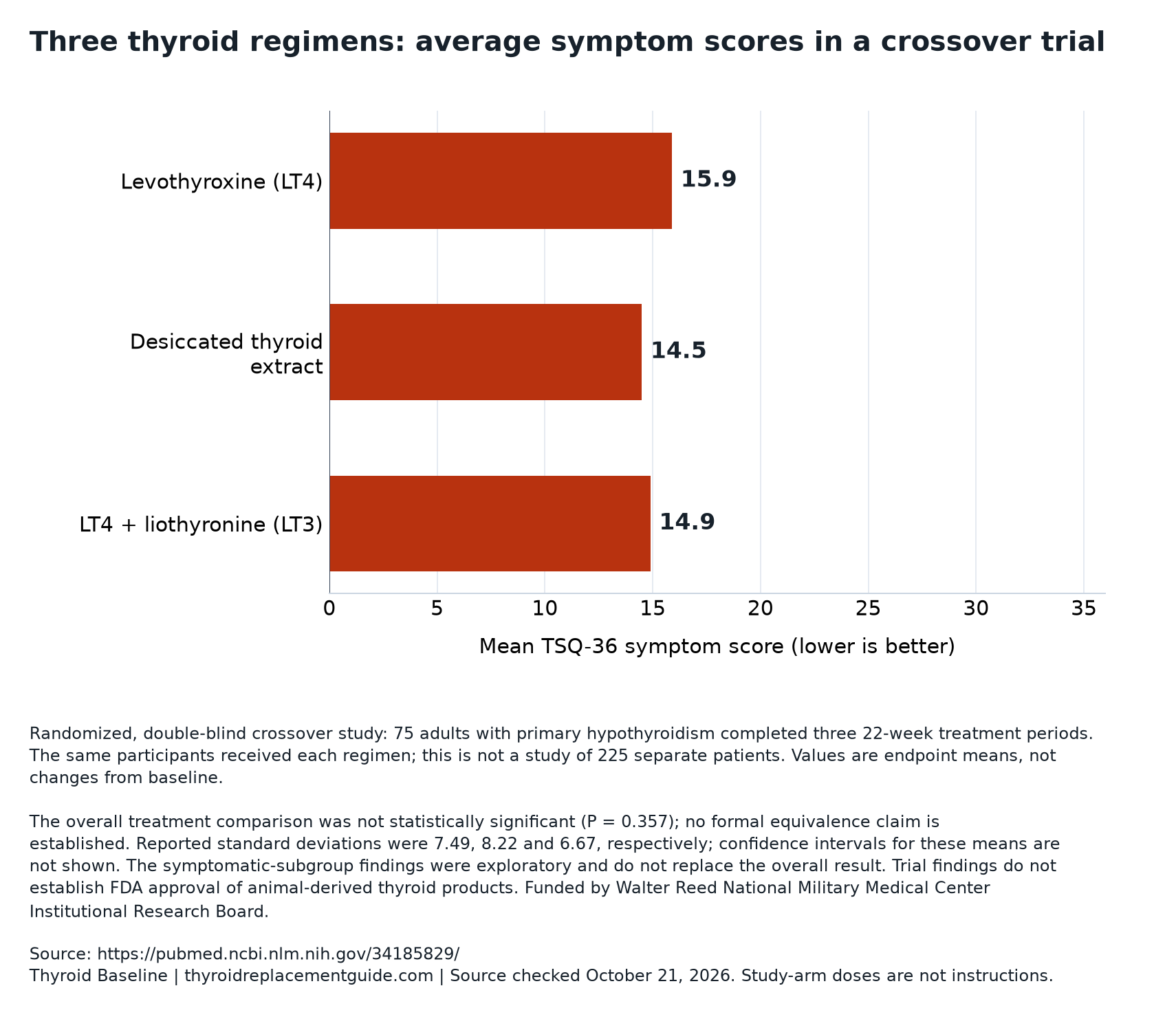
Overall symptom result: Mean TSQ-36 scores were 15.9 with levothyroxine, 14.5 with desiccated thyroid extract, and 14.9 with combination treatment; the overall comparison was not statistically significant. Source 1
Subgroup evidence: The most symptomatic TSQ-36 category contained 20 participants. Its favorable findings were exploratory, not the trial’s primary result. Source 1
Safety and regulatory context: No adverse effects were reported, but heart rate was higher during desiccated thyroid extract treatment. Animal-derived thyroid medications are not FDA approved. Source 1 Source 4
Established replacement therapy was the starting point
The participants had primary hypothyroidism: underactive thyroid function originating in the thyroid gland. They were military health-system beneficiaries receiving stable replacement treatment. Although eligibility allowed ages 18–65, the people who completed the trial were 29–65, with an average age of 50. Women represented 77.3% of the group, and 77.3% were White. This was a selected treated population, not a screening sample of everyone with fatigue or an elevated thyroid-stimulating hormone level.
The causes of hypothyroidism included Hashimoto autoimmune disease in 46 people, thyroid removal in 16, previous radioactive iodine treatment for Graves disease in four, and an unspecified cause in nine. Including several causes broadened the comparison, but those small categories cannot establish separate treatment conclusions for each diagnosis. In particular, having 16 participants after thyroidectomy does not make this a definitive post-thyroidectomy trial.
The distinction matters before interpreting any medication comparison. The symptoms and testing guide explains the importance of establishing the original diagnostic context. Here, the research question concerned alternative replacement treatments in people already treated for primary hypothyroidism—not whether nonspecific symptoms alone justify thyroid hormone.
Read the underlying chart data: download CSV or download the source-labeled chart.
A crossover design gave each person three comparisons
Researchers enrolled 90 people, but 15 withdrew because of relocation or scheduling conflicts before randomization. The remaining 75 completed the study. Each received oral levothyroxine, or LT4; desiccated thyroid extract, or DTE; and LT4 plus liothyronine, or LT3, in a randomized treatment sequence. LT4 supplies T4, whereas the other two approaches contain T3 as well.
The research pharmacy placed the medications in identical capsules. Participants, investigators, cognitive-test administrators, and test-result analysts were blinded to treatment identity. Each period lasted 22 weeks: thyroid-stimulating hormone, or TSH, was checked after six weeks, with dose adjustment intended to maintain the study reference range, followed by another 16 weeks. Repeating that structure across three treatments produced about 66 weeks of treatment observation per participant.
Crossover trials reduce the influence of stable differences between people because each participant serves as their own comparator. They do not turn 75 people into 225 independent participants. The mixed-effects analysis accounted for repeated observations within individuals. The tested once-daily oral regimens also do not directly establish results for different formulations, dosing schedules, or compounded products.
How the three-treatment comparison was organized
| Design feature | What the trial did | Why it matters |
|---|---|---|
| Population | 75 adults with treated primary hypothyroidism completed all periods | Results concern replacement-treatment comparisons |
| Comparator structure | Each participant received LT4, DTE, and LT4 plus LT3 | Comparisons were within people, not three independent groups |
| Treatment duration | 22 weeks per treatment; approximately 66 weeks overall | A period-end result reflects months on each treatment |
| Masking | Identical capsules and blinded assessments | Reduced expectation and assessment bias |
| Laboratory management | TSH assessment after six weeks with study-directed adjustment | Treatments were compared under monitored conditions |
The endpoints measured different parts of feeling better
The primary outcomes were thyroid-related symptoms, general psychological well-being, depressive symptoms, and memory performance. These were assessed with the TSQ-36, GHQ-12, Beck Depression Inventory, and Wechsler Memory Scale IV. The memory assessment included five domains rather than a single global score. A treatment that changes one aspect of memory therefore need not improve cognition broadly.
The researchers developed their thyroid symptom questionnaire using earlier hypothyroid-specific questionnaires as models. It contained 12 questions and asked participants about the preceding 22 weeks. That makes its time frame relevant to the treatment period, but its study-specific development is important when judging how readily a score difference translates into a noticeable everyday improvement.
Average Beck Depression Inventory scores were around seven on every treatment, within the report’s range for normal mood variation. This relatively low group average left less room for improvement than would exist in a population selected for substantial depressive symptoms. Baseline severity therefore influences what an average treatment comparison can reveal, a distinction also discussed in the T4 and T3 evidence guide.
The overall results did not identify a superior treatment
Mean TSQ-36 scores were 15.9 on LT4, 14.5 on DTE, and 14.9 on LT4 plus LT3. The overall treatment comparison yielded P = 0.357. Subtracting the displayed averages gives numerical differences of 1.4 points for DTE versus LT4 and 1.0 point for combination treatment versus LT4. These are descriptive differences, not evidence by themselves that one treatment was clinically better.
The reported standard deviations were 7.49, 8.22, and 6.67, respectively. A standard deviation describes variation in scores; it is not a confidence interval around the treatment difference. Because this was a crossover study, uncertainty in a within-person treatment contrast cannot be reconstructed correctly by treating these three sets of scores as unrelated samples.
GHQ-12, depression scores, and all five memory domains likewise showed no statistically significant overall treatment differences. However, failure to detect superiority does not prove formal equivalence. The sample-size calculation targeted an eight-point within-person TSQ difference, requiring 67 participants under its assumptions. It was not an equivalence design with a predefined margin establishing that all clinically relevant differences had been excluded.
Selected overall findings: numerical differences are not automatically treatment benefits
| Measure | LT4 / DTE / LT4 plus LT3 | Interpretation |
|---|---|---|
| TSQ-36, mean (SD) | 15.9 (7.49) / 14.5 (8.22) / 14.9 (6.67) | No significant overall difference; P = 0.357 |
| GHQ-12, mean | 11.9 / 11.7 / 11.6 | No significant overall difference; P = 0.891 |
| Beck Depression Inventory, mean | 7.15 / 7.09 / 7.33 | No significant overall difference; P = 0.947 |
| Resting heart rate, beats/minute | 71.5 / 73.7 / 70.4 | Higher during DTE treatment; overall P = 0.04 |
| Predose total T3, ng/dL | 103 / 155 / 132 | Biochemical differences did not establish overall symptom superiority |
Worse symptoms on LT4 defined an exploratory question
The investigators then ranked participants according to their results during the LT4 period and created low, middle, and high symptom categories, described as terciles. For TSQ-36, the categories contained 30, 25, and 20 people. Thus, the highest-symptom group was not exactly one-third of the sample. It consisted of 20 people with scores above 21 through 33.
Participants in that highest TSQ category showed larger improvements with both T3-containing approaches than those in the lower categories. Similar patterns appeared for depressive symptoms. For general well-being, the more symptomatic group improved with LT4 plus LT3, but the DTE findings were numerical rather than statistically significant. That distinction is lost if every questionnaire is described as supporting both alternatives equally.
Among memory measures, people with the lowest visual-memory performance on LT4 improved with T3-containing treatment. The pattern was not uniform across memory domains, and biochemical or metabolic measures did not show corresponding favorable subgroup responses. These findings point toward a possible symptom-defined population for future trials, not a demonstrated universal benefit or a validated responder test.
Selecting the worst scores creates a statistical challenge
The subgroup analysis used LT4-period scores both to identify poor performers and as the reference for changes on other treatments. This creates an opportunity for regression to the mean: an unusually bad measurement may be followed by a less extreme measurement even without a treatment-specific effect. Randomization and blinding strengthen the trial, but they do not remove this problem from a subgroup selected using observed outcomes.
The authors acknowledged that possibility, while arguing that consistency across questionnaires and treatment preferences made a wholly statistical explanation less persuasive. That argument is reasonable to investigate, but correlated questionnaires are not fully independent replications. Measures that capture overlapping aspects of well-being can move together for reasons other than a distinct hormone-response mechanism.
The analysis also involved many secondary outcomes and subgroup comparisons. Some within-measure comparisons received multiplicity adjustments, but no overall correction covered the full set of subgroup analyses. More testing increases opportunities for chance findings. A stronger next study would recruit persistently symptomatic patients prospectively, define the main outcome in advance, and be sized to test that specific population rather than discover it afterward.
Blood hormone changes did not establish a brain mechanism
Morning fasting blood samples were collected before the day’s dose. Mean total T3 was 103 ng/dL on LT4, 155 on DTE, and 132 on combination treatment. T4 concentrations were lower with T3-containing treatments. Mean TSH values remained within the reference range, although they differed: 1.63, 2.34, and 1.76, respectively.
These results confirm that the treatment approaches produced different circulating hormone profiles. They do not show that a higher T3 value caused symptom improvement. The report found no established correlation between serum T3 and outcomes, including in subgroup analyses. Predose sampling also cannot describe the full daily pattern of T3 exposure, because T3 changes more quickly than T4.
The authors proposed that brain thyroid-hormone signaling might remain incompletely restored in some people receiving LT4. That remains a hypothesis, not a mechanism demonstrated by this trial. Neither disease cause nor the tested DIO2 genetic variant identified a clear response pattern, and the homozygous variant group was too small for meaningful certainty. The follow-up laboratory guide provides context for interpreting a blood result without treating it as a direct measure of every tissue’s function.
Preference and tolerability were informative but limited
The preference table showed more first-place rankings for DTE than for either alternative, but the formal preference analysis found no statistically significant difference. Several participants tied treatments or expressed no preference. Preference is a meaningful patient-centered outcome, yet a numerical ranking alone does not establish superiority or predict how another person would respond.
No adverse effects were reported, and nobody withdrew because of side effects. Nevertheless, mean resting heart rate was 73.7 beats per minute on DTE, compared with 71.5 on LT4 and 70.4 on combination treatment; the overall P value was 0.04. Blood pressure did not differ significantly. The heart-rate finding should accompany—not disappear behind—the statement that no adverse effects were reported.
The study excluded cardiac disease and several other significant conditions, and 22 weeks on each treatment cannot settle long-term cardiac or skeletal safety. Official Synthroid information separately warns about cardiac effects and bone loss with over-replacement. Body weight and lipids did not differ significantly in this trial, reinforcing the distinction addressed in thyroid hormone is not a weight-loss treatment.
TRUST tested treatment initiation in a different population
TRUST addressed another clinical question entirely. It randomized 737 adults aged at least 65 with persistent subclinical hypothyroidism—elevated TSH but normal free T4—to oral levothyroxine or placebo. Mean age was 74.4, and baseline mean TSH was 6.40 mIU/L. Unlike the crossover study, it compared treatment initiation with placebo in parallel groups, not three replacement approaches in the same treated people.
At one year, TSH was lower with levothyroxine, but patient-reported symptoms did not improve relative to placebo. The reported between-group difference was 0.0 points for hypothyroid symptoms, with a 95% confidence interval from −2.0 to 2.1, and 0.4 points for tiredness, with an interval from −2.1 to 2.9. Both scales ranged from 0–100, and the stated minimum clinically important difference was nine points.
Those intervals help show why a biochemical change need not translate into a meaningful symptom benefit in that population. They do not justify withdrawing necessary replacement in overt hypothyroidism or after thyroid removal. The TRUST scientific analysis explores that boundary. This comparison uses TRUST’s indexed primary abstract, not a review of its complete protocols or supplements. Funding included European Union FP7 and others; no significant excess of prespecified serious adverse events was reported.
Research evidence, product status, and care arrangements are separate
The crossover trial received funding from the Walter Reed National Military Medical Center Institutional Research Board. One author disclosed consulting relationships with Synthonics, BLA Technology, and Allergan; the others reported no competing financial interests. These details support transparency, but the central interpretive limits remain the overall null findings, exploratory subgroup design, and selected sample.
A historical trial also does not confer regulatory approval. FDA states that animal-derived thyroid medications, including DTE products, are not FDA approved. Its current account describes planned guidance and a risk-based enforcement approach, with concerns about potency, purity, variable hormone levels, and impurities. It does not support describing a blanket withdrawal deadline. FDA-approved synthetic levothyroxine and liothyronine options exist, but approval status and comparative symptom benefit remain different questions.
Editorial interpretation: a care arrangement should be evaluated for documented follow-up responsibilities, not inferred benefits from this trial. Readers can use the Paloma Health review and PlushCare review to check documentary terms around membership or visits. Those links do not establish that either provider offers the studied treatments or reproduces the trial’s outcomes. No provider, pharmacy, or compounded formulation inherits clinical results simply by referencing the same hormone names.
Questions about the evidence
Did the trial prove that all three treatments work equally well?
No. It found no statistically significant overall differences on its primary symptom, well-being, depression, and memory outcomes. Formal equivalence would require a different framework with a predefined acceptable difference. The trial supports a conclusion of no demonstrated overall superiority, while leaving uncertainty about smaller differences and particular patient groups.
Does the symptomatic subgroup establish who needs T3?
No. The subgroup was defined using scores recorded during LT4 treatment, and the highest TSQ category contained only 20 people. Multiple testing and regression to the mean complicate interpretation. The findings justify a prospectively designed study of persistent symptoms, but they do not validate a questionnaire threshold, blood test, or genetic test for choosing treatment.
Why can a normal TSH coexist with different symptoms?
TSH is a laboratory measure of thyroid feedback, whereas questionnaires measure lived symptoms and well-being. The trial documented variation in symptoms despite reference-range TSH, but it did not establish the cause of that variation. In particular, different blood T3 concentrations did not prove that altered thyroid signaling in the brain explained the subgroup findings.
Does the lack of reported adverse effects settle safety?
No. Participants were selected to exclude cardiac disease and other important conditions, and exposure to each treatment lasted 22 weeks. DTE was associated with a higher mean heart rate. Longer-term risks, including uncommon cardiac events and skeletal effects, require evidence beyond this study; official levothyroxine labeling also recognizes risks from over-replacement.
Can TRUST be used to argue against replacement after thyroid removal?
No. TRUST studied older adults with subclinical hypothyroidism and normal free T4, comparing levothyroxine initiation with placebo. It was not a withdrawal trial in people dependent on established replacement. The crossover trial included some participants after thyroid removal, but their number was insufficient to establish a separate, definitive treatment comparison for that population.
What this evidence supports
The strongest finding is the absence of demonstrated overall superiority among the three monitored oral treatment approaches in these 75 adults. The most interesting unresolved finding is a possible benefit from T3-containing treatment among people with greater symptoms during LT4 therapy. Those conclusions occupy different evidence levels. A future trial must identify symptomatic participants before the comparison, specify clinically meaningful outcomes, and provide adequate precision and longer safety follow-up. Until then, baseline diagnosis and symptom severity explain why thyroid studies can answer different questions without contradicting one another.
Research access and limitations
The crossover analysis uses the accessible full primary article. The TRUST comparison uses its indexed primary report abstract, alongside official prescribing information and FDA material for safety and regulatory context. No individual treatment conversion, regimen recommendation, provider outcome claim, or long-term safety conclusion follows from these data.