Study facts at a glance
Who participated: TRUST randomized 737 adults aged at least 65; mean age was 74.4 years, and all had persistent elevated TSH with normal free T4. Source 1
Laboratory response: Mean TSH was 6.40 mIU/L initially and reached 3.63 with levothyroxine versus 5.48 with placebo at one year. Source 1
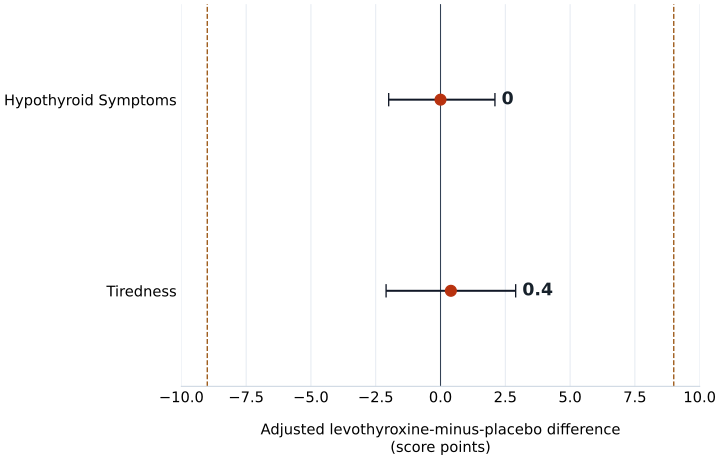
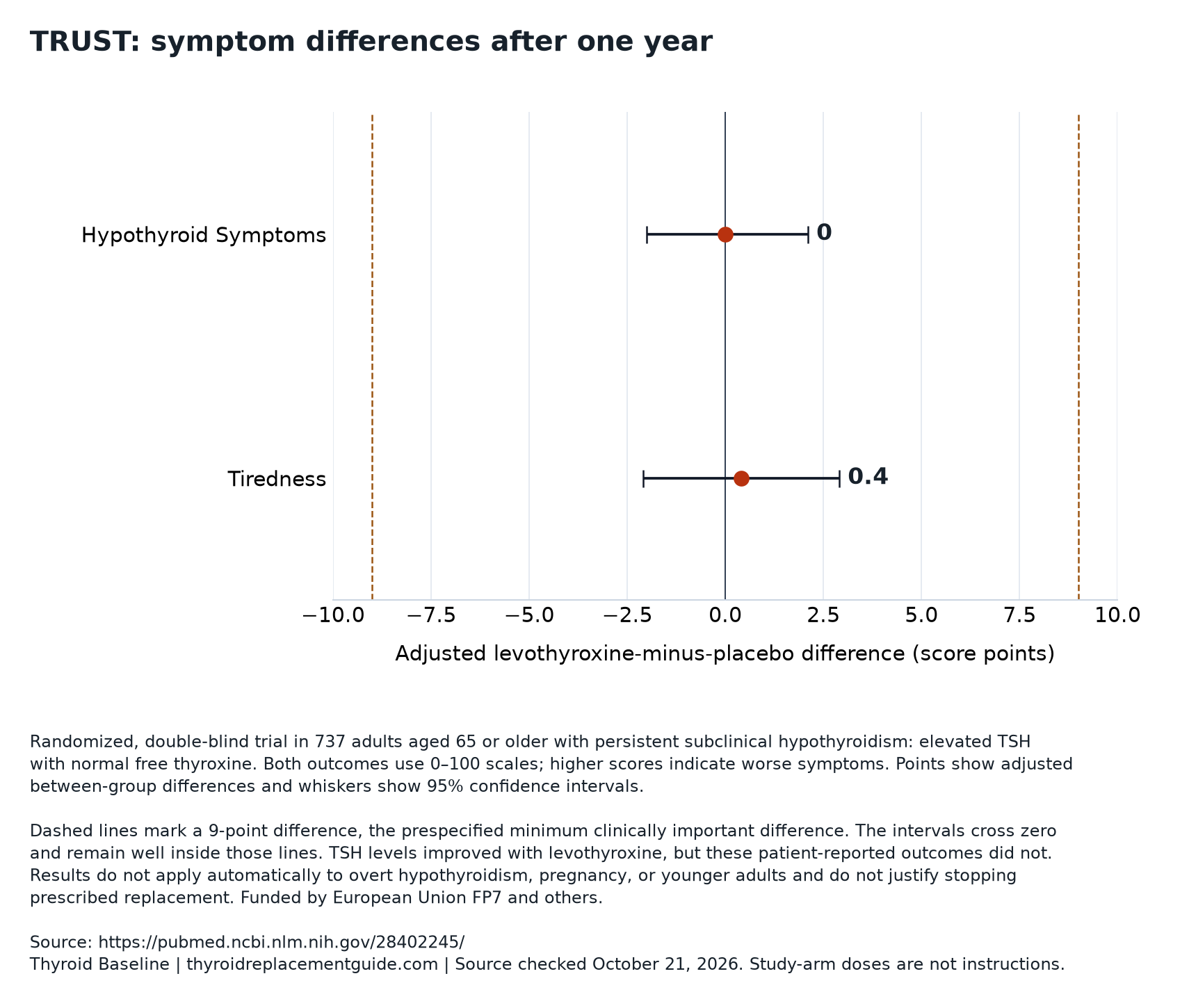
Primary symptom result: The between-group difference in hypothyroid symptom change was 0.0 points, with a 95% confidence interval from −2.0 to 2.1. Source 1
Tiredness result: The reported between-group difference was 0.4 points, with a 95% confidence interval from −2.1 to 2.9; the stated clinically important difference was 9 points. Source 1
Related analyses overlap: The higher-symptom secondary analysis and the pooled analysis in adults 80 or older reused TRUST participants; they are not two fully independent replications. Source 3 Source 4
The diagnosis defined the question before treatment began
Subclinical hypothyroidism is a biochemical category: TSH is elevated while free T4 remains within the laboratory reference range. TSH is a signal involved in regulating thyroid hormone production; it is not itself a symptom measurement. TRUST required persistent disease, with entry TSH from 4.60 to 19.99 mIU/L. The average starting TSH was 6.40, placing the study's center of gravity toward mild elevation rather than the upper end of eligibility.
The participants' mean age was 74.4 years, and 396, or 53.7%, were women. These details matter because an eligibility range does not mean every part of that range was equally represented. The overall estimate therefore speaks most directly to the older population actually enrolled, not automatically to someone with a substantially different hormonal deficit. The symptoms and testing guide explains why pairing symptoms with the original laboratory pattern is a useful starting point.
Overt hypothyroidism, younger adulthood, pregnancy, and replacement after thyroid removal are not interchangeable with this population. In particular, TRUST did not test whether people who lack adequate thyroid hormone should go without replacement. Its question was whether adding levothyroxine for persistent subclinical disease in older adults improved clinical outcomes.
Read the underlying chart data: download CSV or download the source-labeled chart.
Randomization separated the drug effect from change over time
TRUST was a double-blind, randomized, placebo-controlled, parallel-group trial. Investigators assigned 368 participants to oral levothyroxine and 369 to placebo. Parallel-group means participants remained in their assigned comparison group rather than cycling through treatments. Blinding and a matching placebo reduced the chance that knowing the assignment would influence symptom reporting or study management.
The levothyroxine arm began at 50 micrograms daily, or 25 micrograms for participants weighing under 50 kilograms or with coronary heart disease. Investigators adjusted treatment according to TSH; the placebo group underwent mock adjustment. These numbers describe research arms, not a personal dosing plan. At one year, the median levothyroxine dose was 50 micrograms.
The placebo comparison is central to the interpretation. Symptoms can fluctuate, and repeated testing can change even without active treatment. Comparing the two randomized groups asks how much additional improvement was attributable to the treatment strategy, rather than counting every improvement after enrollment as a medication benefit. Funding was reported from European Union FP7 and other sources.
TSH changed, so the negative symptom finding was informative
At one year, mean TSH was 3.63 mIU/L with levothyroxine and 5.48 with placebo. The difference between those follow-up means was 1.85 mIU/L. That is a laboratory concentration difference, not a percentage-point reduction in symptoms or a measure of how much better participants felt.
The placebo group's TSH also declined from the overall starting mean. Because that starting value summarizes the whole trial rather than each arm separately, it should not be used to reconstruct precise arm-specific changes. The defensible observation is that treatment produced clear separation in follow-up TSH without corresponding separation in the primary symptom outcomes.
Interpretation: this makes the trial more informative than a study in which treatment barely changed the intended biological marker. It shows that a laboratory response and a patient-experienced response can diverge in this population. It does not establish why they diverged or prove that TSH is irrelevant in other thyroid conditions. The follow-up laboratory guide develops that distinction between a measurement and its clinical meaning.
The primary outcomes measured symptoms, not laboratory normalization
The two primary outcomes were one-year changes in the Hypothyroid Symptoms and Tiredness scores from a thyroid-related quality-of-life questionnaire. Each scale ran from 0 to 100, with higher scores indicating worse symptoms. The report specified 9 points as the minimum clinically important difference—a benchmark for a difference large enough to matter clinically, rather than merely being detectable statistically.
For hypothyroid symptoms, mean change was 0.2 points in both groups. The reported between-group difference was 0.0, with a 95% confidence interval from −2.0 to 2.1. For tiredness, mean changes were 3.2 with placebo and 3.8 with levothyroxine, but the report's between-group estimate was 0.4, with a confidence interval from −2.1 to 2.9. Subtracting the displayed rounded means is not a substitute for that reported estimate.
These are score points, not percentages of people helped. Nor do average changes mean every participant had the same experience. Nevertheless, both confidence intervals lie well inside a 9-point difference in either direction, providing stronger evidence against a clinically important average benefit at one year than a bare statement that a statistical test was negative.
TRUST's one-year patient-reported outcomes: reported treatment differences and their scale
| Outcome | Between-group difference, 95% CI | Clinical reading |
|---|---|---|
| Hypothyroid Symptoms | 0.0 points; −2.0 to 2.1 | No average advantage; interval far smaller than the 9-point benchmark |
| Tiredness | 0.4 points; −2.1 to 2.9 | No average advantage; use the reported estimate, not rounded-arm subtraction |
| Scale interpretation | 0–100 points; higher is worse | Negative treatment differences favor levothyroxine; these are not percentage changes |
More symptomatic participants did not show an added benefit
A reasonable question followed the main result: could modest symptom burden have obscured benefit among people who felt substantially worse? A secondary TRUST analysis examined 638 participants with complete outcome data. High symptom burden meant a starting Hypothyroid Symptoms score above 30 or a Tiredness score above 40. There were 132 participants above the symptom threshold and 133 above the tiredness threshold; these counts should not be added as though they necessarily represented different people.
Among those with high symptom burden, hypothyroid symptom scores improved by 12.3 points with levothyroxine and 10.4 with placebo. The adjusted treatment difference was −2.0 points, with a 95% confidence interval from −5.5 to 1.5. For tiredness, within-group improvements were 8.9 and 10.9 points, respectively, while the adjusted between-group difference was 0.0, with an interval from −4.1 to 4.0.
Thus, substantial improvement after enrollment occurred without evidence that levothyroxine caused additional improvement. The analysis found no evidence that starting symptom severity modified treatment effects. However, it was post hoc, involved smaller groups, and included only people with one-year outcome data. It addresses an important alternative explanation but is not an independent trial or a definitive map of every possible responder.
The analysis after age 80 was planned, but partly reused TRUST
A prospectively planned combined analysis focused on 251 community-dwelling adults aged 80 or older, with mean age 85. It combined 105 participants from one trial with 146 older participants from TRUST. Assignment totals were 112 to levothyroxine and 139 to placebo; 212 participants, or 84%, completed the study. Unlike the high-symptom analysis, this pooled analysis was planned prospectively.
At one year, the adjusted hypothyroid symptom difference was 1.3 points, with a 95% confidence interval from −2.7 to 5.2. The tiredness difference was −0.1, with an interval from −4.5 to 4.3. Neither estimate supported a clinically important average symptom improvement using the same 9-point benchmark.
The results extend the age-specific assessment, but their relationship to TRUST must remain visible. Counting the main trial, the high-symptom analysis, and this pooled report as three independent confirmations would exaggerate the amount of independent evidence. They are better understood as a main randomized comparison and two analyses that probe particular questions using overlapping participants.
Three reports, different questions, overlapping evidence
| Report | Population and design | What it adds |
|---|---|---|
| Main TRUST trial | 737 randomized adults aged 65 or older | Primary placebo-controlled estimate at one year |
| Higher-symptom analysis | 638 TRUST participants with complete outcomes; post hoc | Tests whether greater starting symptom burden identified added benefit |
| Age-80-and-older analysis | 251 participants pooled prospectively from two trials, including TRUST | Examines the oldest participants without constituting a wholly independent replication |
Safety findings were reassuring within limits, not proof of no risk
The main TRUST abstract reported no significant excess of serious adverse events prespecified as being of special interest. It did not provide detailed event counts in that abstract. This is a finding about what the study detected under its conditions, not proof that treatment carries no serious risk or that uncommon harms were excluded.
In the pooled analysis of participants aged 80 or older, at least one adverse event occurred in 33 of 112 levothyroxine participants, or 29.5%, and 40 of 139 placebo participants, or 28.8%. Those are overall adverse-event proportions, not a causal estimate for a particular cardiac or skeletal complication. Similar totals can also conceal differences in the types of events.
Official Synthroid labeling provides separate safety context: excessive replacement can provoke angina or arrhythmias, including atrial fibrillation, particularly in older adults or people with cardiovascular disease. Over-replacement can also increase bone resorption and reduce bone mineral density. These established concerns explain why the absence of an average symptom benefit cannot be interpreted without considering the consequences of unnecessary hormone exposure.
The three-treatment crossover study asked a different question
A separate randomized, double-blind crossover study compared levothyroxine alone, levothyroxine plus liothyronine, and desiccated thyroid extract in 75 adults with established primary hypothyroidism. Participants actually ranged from 29 to 65 years and were already receiving thyroid treatment. Each person received each treatment for 22 weeks—approximately 66 weeks across three periods—not 22 weeks total and not 225 separate participants.
Overall symptom, general health, depression, and memory outcomes did not differ significantly between treatments. A secondary analysis suggested benefits on selected measures among participants who performed worst while taking levothyroxine, but those smaller subgroup findings were not the primary powered comparison. The authors acknowledged regression to the mean and the challenges of multiple analyses. Desiccated thyroid extract also produced a modestly higher mean heart rate.
This is not a contradiction of TRUST. Comparing replacement formulations in already-treated primary hypothyroidism differs from asking whether to add hormone for subclinical disease in older adults. The three-treatment crossover article examines that study in detail, while the T4 and T3 evidence guide places formulation questions in context. The crossover trial received institutional research funding from Walter Reed National Military Medical Center.
What remains unresolved is narrower than whether thyroid treatment works
TRUST's confidence intervals constrain the average one-year effect on its two primary scales. They do not identify the cause of an individual's fatigue, establish lifetime outcomes, or show that every participant responded identically. The main abstract also reported no beneficial effects on secondary outcomes, but it does not provide the detailed estimates needed to evaluate each separately.
One unresolved issue is how well the overall result represents less common presentations within the eligibility range. A mean starting TSH of 6.40 does not supply a separate estimate for people near 20 mIU/L. Likewise, the higher-symptom analysis reduces uncertainty about one proposed responder group without establishing that every biologically distinct subgroup has been adequately studied.
Interpretation: the practical scientific lesson is to specify the proposed benefit before judging treatment success. A lower TSH is evidence of a biochemical response; a symptom benefit requires a symptom comparison. Weight loss is a separate issue altogether: official labeling includes a boxed warning against using thyroid hormones for obesity or weight reduction, as discussed in the thyroid hormone and weight-loss guide.
The care implication is a clearer question, not a universal medication rule
Interpretation: a useful care record distinguishes the original diagnosis, the intended treatment goal, and the measure used to assess that goal. For TRUST-like disease, promising symptom improvement simply because TSH falls would go beyond the randomized result. For established hormone deficiency, using TRUST to declare replacement unnecessary would make the opposite error.
The study did not compare care companies, membership models, pharmacies, compounded products, or alternative formulations. Its results therefore do not establish the quality or outcomes of a particular service. For documentary questions about visit scope, ongoing responsibilities, or contract terms, readers can consult the Paloma Health review and PlushCare review; neither link implies that a provider offers the studied treatment strategy or reproduces trial outcomes.
Individual decisions require the actual clinical context, including cardiovascular status, other medications, laboratory history, and the nature of the thyroid condition. TRUST supports a focused discussion about expected symptom benefit in older adults with subclinical disease. It supplies neither a personal dosing protocol nor a reason to independently start, stop, or change established replacement.
Questions about the evidence
Does a normal free T4 mean the symptoms are not real?
No. Normal free T4 defines part of the subclinical biochemical pattern; it does not invalidate fatigue or other symptoms. TRUST tested whether adding levothyroxine improved those symptoms beyond placebo. Its negative average result does not identify an alternative cause, and a symptom questionnaire cannot by itself establish which biological process produced a person's complaints.
How can people improve substantially if the drug showed no benefit?
Improvement within a treatment group is different from improvement attributable to treatment. In the higher-symptom analysis, both levothyroxine and placebo groups improved substantially. Natural fluctuation, regression toward more typical scores after an unusually symptomatic period, and other influences are possible explanations. The randomized between-group comparison estimates the added medication effect; it did not show an advantage.
Do the confidence intervals rule out every possible benefit?
No. They describe uncertainty around average treatment differences on specific scales at one year. In the main trial, the intervals were narrow relative to the 9-point clinically important difference, arguing against a large average benefit on those outcomes. They do not prove identical responses among individuals or answer every longer-term clinical question.
Does TRUST apply to replacement after thyroid surgery?
Not directly. TRUST enrolled older adults with persistent elevated TSH and normal free T4, not a population selected for replacement needs after thyroid removal. Official levothyroxine labeling includes replacement for acquired hypothyroidism. The separate crossover study included some post-thyroidectomy participants, but it compared replacement formulations rather than replacement against placebo.
Why not describe levothyroxine as harmless if serious events were not increased?
A trial can fail to detect an excess without excluding uncommon, delayed, or context-dependent harms. TRUST's abstract reported no significant excess in selected serious events, while official labeling warns about cardiac effects and bone loss with over-replacement. Benefit and harm therefore need separate evaluation; a negative symptom result is not a universal safety guarantee.
What this evidence supports
TRUST provides a strong randomized answer to a specific question: in older adults with persistent subclinical hypothyroidism, centered on mildly elevated TSH, levothyroxine lowered TSH without producing a clinically important average improvement in hypothyroid symptoms or tiredness at one year. Analyses of higher symptom burden and age 80 or older did not reveal a different average symptom result, although they overlap with the main trial. The most defensible interpretation preserves both findings—the biochemical effect and the absent symptom advantage—without extending them to all thyroid replacement.
Research access and limitations
TRUST and its two related analyses are assessed from indexed primary report abstracts, not a review of their complete protocols, supplements, or full articles. The separate crossover comparison is assessed from its accessible primary full text. Official Synthroid labeling supplies indication and safety context rather than additional TRUST outcome data. Abstract-level reporting limits assessment of detailed secondary outcomes, missing-data methods, uncommon harms, and less-represented diagnostic subgroups.